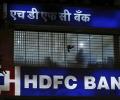
HDFC Bank on Monday reported a consolidated net profit of Rs 16,811 crore for the September quarter, its maiden quarterly earnings announcement after merging parent HDFC with itself. On a standalone basis, the largest private sector lender reported a net profit of Rs 15,976 crore. In the year-ago period, the net profit of the merged entity would have been Rs 11,162 crore on a consolidated level while the same on a standalone basis would have been Rs 10,606 crore.

The Centre needs to have dialogue with the Opposition instead of letting politics come in the way; it needs to stoop to conquer, says Aditi Phadnis.
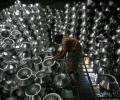
Hindalco's first quarter (Q1FY23) results indicate healthy domestic volumes for aluminium and copper, and lower cost of production. Subsidiary Novelis saw weak volume trends but it managed to push operating profit margins on a better mix and pricing hikes. The weak global outlook on aluminium is a cause for ongoing concern.

Notwithstanding the windfall tax placing a cap on profits, oil and gas producers like Oil India (OIL) and Oil and Natural Gas Corporation (ONGC) have done well in the October-December quarter (third quarter, or Q3) of 2022-23 (FY23). ONGC faces the drag of poor results from its subsidiary Hindustan Petroleum Corporation, and in comparative terms, OIL is better off. Standalone net sales in Q3FY23 stood at Rs 5,900 crore - up 57 per cent year-on-year (YoY), up 2 per cent quarter-on-quarter (QoQ).

Next year Medica and Manipal will merge, making the amalgamated entity the largest corporate hospital chain in the country, overtaking Apollo Hospitals Enterprises.

'The first duty of the government is to learn lessons from a bad experience and course correct. It's a pity that the government is making policy without looking at evidence and differentiating between immediate and urgent.'

The central government is likely to further consolidate its fiscal deficit by 50 basis points (bps) to 5.9 per cent in FY24 from 6.4 per cent in FY23, according to a recent report released by Goldman Sachs on Tuesday. In the current fiscal year, there is going to be an upside of 0.5 per cent on the receipts side due to higher nominal GDP growth, and higher tax buoyancy because of the formalisation, the report said. The upside to expenditure is mainly going to come from incremental subsidies (0.8 per cent of GDP), in both food and fertilizer, it said. The upcoming pre-election Budget will carry forward the trend of the increased capital expenditure seen in recent years.


Employees joining companies after August and availing of the government benefits under the Pradhan Mantri Rojgar Protsahan Yojana (PMRPY) will also have to link their PF accounts with Aadhaar numbers.

'Investors should ideally consider equity allocations from a medium-to-long term perspective.'

There's a hint of new competition riding into a sector that has attracted attention for being in a duopoly-like situation. Rapido, a commute app known for its budget-friendly bike-taxi services, on Tuesday announced its entry into the cab market, which is currently dominated by marquee brands Uber and Ola. Rapido's cab foray will be enabled by a software as a service (SaaS)-based platform.

Ulhas Joshi, Head -- Sales, Rank MF, a mutual fund investment platform, answers your queries.

From the Sensex pack, Mahindra & Mahindra climbed 3.71 per cent after the company reported an 18 per cent jump in its consolidated profit for the March quarter and the highest-ever annual profit of Rs 10,282 crore in FY23. Titan, Tata Steel, HDFC, UltraTech Cement, State Bank of India, ITC, IndusInd Bank, NTPC, HDFC Bank and Bajaj Finserv were the other major gainers. HCL Technologies, Power Grid, Maruti, Wipro, Tata Consultancy Services, ICICI Bank, Infosys, Tech Mahindra and Hindustan Unilever were the laggards.

If you have seen Zwigato, Param Kumar's story will sound familiar. Laid off from his job as a repairman at a Gurugram-based water purifier provider, he now delivers groceries and food for a mobile-based delivery app, in Delhi. Kumar, who started making deliveries last August, told Business Standard that he is working longer hours than his older salaried job as an RO repairman, and has no paid leaves or health insurance. Kumar is part of India's estimated 7.7 million-strong force of gig workers.
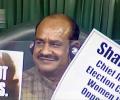
The Opposition intensified its noisy protests in Lok Sabha on Wednesday over Pegasus snooping, farm laws and other issues with some unruly members even hurling papers and torn placards in the House, but the government went ahead with its legislative agenda and three bills were passed amid the din.

According to DMK, the voters are already consolidated on ideological lines, hence the impact of anti-incumbency, whether against the BJP Centre or the DMK state may not be too much, notes N Sathiya Moorthy.

The effect of the HDFC-HDFC?Bank merger will be for the bigger space of the Indian financial sector and not just limited to the banking sector. The large finance companies have practically no benefit of regulatory arbitrage. Earlier, such arbitrage between banks and NBFCs was normal. The logic of the merger is very clear - the cost of borrowing of banks is lower.
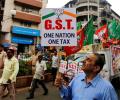
The 41st meeting of the GST Council, to be held via video conferencing, has just one agenda for discussion -- making up for shortfall in states' revenues, sources said.

From the Sensex pack, NTPC, Bajaj Finance, IndusInd Bank, UltraTech Cement, Bajaj Finserv, State Bank of India, Tata Motors, ITC, Power Grid and Larsen & Toubro were the biggest gainers. IndusInd Bank climbed 2 per cent after the company on Tuesday reported a 30 per cent jump in consolidated net profit in April-June quarter at Rs 2,124.50 crore, helped by core income growth and lower bad loan provisions.
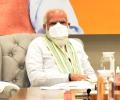
'I would like to convey the message to your readers that the prime minister himself is directly seized of the situation on the ground. He periodically reviews the situation on the ground and how it is moving forward, taking inputs from economists, business leaders, chambers of commerce.'

Equity benchmark index Sensex buckled under selling pressure for the second straight session to close below the 65k mark on Friday, as investors offloaded IT, teck and metal stocks amid a bearish global trend. Besides, fresh foreign fund outflows also hit investor sentiments, traders said. In a volatile trade, the 30-share BSE Sensex declined 202.36 points or 0.31 per cent to settle at 64,948.66.
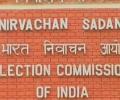
The Election Commission on Friday virtually made it mandatory for political parties to deposit their funds in banks and not to exceed ceiling limits in financial assistance for candidates to ensure transparency and accountability.

The need for finding options for proper functioning of Parliament is of paramount importance as the frequency of the passage of Budgets and other economic Bills without discussion or debate has only increased in the last few years, notes A K Bhattacharya.
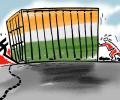
India has been relatively insulated from the severe headwinds in the West. However, with a third of the global economy expected to slip into recession in calendar year 2023, the impact will strongly be felt on India's exports and trade economy, leading economists said in a panel discussion at the Business Standard BFSI Insight Summit in Mumbai on Wednesday. The panel comprised former Reserve Bank of India executive director and former Monetary Policy Committee member Mridul Saggar, State Bank of India Chief Economic Advisor Soumya Kanti Ghosh, Citibank India Chief Economist Samiran Chakraborty, ICRA Chief Economist Aditi Nayar, and IndusInd Bank Chief Economist Gaurav Kapoor. The topic of the panel discussion was No recession in sight: Is India decoupled from developed economies?

One-sponsor-one-fund rule may set off merger as Amundi seen sponsoring two funds following buyout.

Increase in Budgetary allocation likely to be only 5.8%, the lowest in six years

India overtook China to add the most number of new unicorns--start-ups valued at $1 billion or more--in the first half of 2022 despite a funding winter haunting entrepreneurs in the south Asian nation. India added 14 new unicorns in the period (H1 2022) and China had 11, according to the Hurun Global Unicorn Index 2022. The US led the ranking by adding 138 start-ups in the unicorn club.

Terrorism is the biggest curse for the society, he said, adding that if there is any country which bore the maximum brunt of terrorism, it is India.
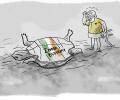
S&P Global Ratings on Tuesday affirmed India's sovereign rating at the lowest investment grade of 'BBB-' for the 14th year in a row with a stable outlook, and said that the country's strong external settings will act as a buffer against financial strains despite elevated government funding needs over the next 24 months. The sovereign credit ratings on India reflect the economy's above-average long-term real GDP growth, sound external profile, and evolving monetary settings, S&P Global Ratings stated. "India's democratic institutions promote policy stability and compromise, and also underpin the ratings. "These strengths are balanced against vulnerabilities stemming from the country's low per capita income and weak fiscal settings, including consistently elevated general government deficits and indebtedness," it said in a statement. S&P Global Ratings has forecast economic activity in India to begin to normalise throughout the remainder of fiscal 2022, resulting in real GDP growth of about 9.5 per cent.

Swift gains on Dalal Street this year have also led to a sharp surge in shares of equity market intermediaries like depositories, exchanges, and registrar and transfer Agents (RTAs). The stock prices of BSE, CDSL, CAMS, and KFin Technologies are up 24-283 per cent so far in 2023 when compared to a 9 per cent rise in the benchmark Nifty index. With the market buoyancy expected to keep up the pace, analysts believe these stocks are a good long-term bet despite the sharp rally, which can trigger an intermittent correction.

Omkeshwar Singh, Head, Rank MF, a mutual fund investment platform, answers your queries.

While Congress and the states ruled by non-NDA parties pushed for the Centre meeting its statutory obligation of covering the deficit, the Union government cited a legal opinion to say it had no such obligation if there was a shortfall in tax collections. The Centre as well as BJP-JD-U-ruled Bihar were of the opinion that the states should borrow to make up for the shortfall in the tax revenues that have been compounded by the COVID-19 crisis, sources said.

Jet's air operator certificate will lapse on May 19.

Not just unclaimed bank deposits, there are thousands of crores of rupees locked in unclaimed shares and insurance policies lying with many institutions across India.

The Centre has projected reining in its fiscal deficit at 3.3 per cent of GDP in FY19.

Between April 2 and July 8 this fiscal, the rupee has plummeted by 12.81 per cent, and hit all-time low of 61.21 per cent on Monday.

Benchmark indices Sensex and Nifty gained around half a per cent to close at nearly five-month high levels on Monday following continuous foreign fund inflows and firm trends in Asian and European markets. Rising for a second straight day, the 30-share BSE Sensex climbed 317.81 points or 0.51 per cent to settle at 62,345.71, the highest closing level since December 14. During the day, it rallied 534.77 points or 0.86 per cent to 62,562.67.

To threaten China and Pakistan, and then to sharply cut back on military funding, bespeaks a remarkable trust in Beijing and Islamabad that is not borne out by anything they say or do, notes Ajai Shukla.

Most players are looking to invest anywhere between $500 million and $1 billion in new ventures in the next couple of years, said experts on this segment.

Equity benchmarks ended higher on Friday helped by buying in index major Reliance Industries along with fresh foreign fund inflows. Extending its previous day's rally, the 30-share BSE benchmark climbed 203.01 points or 0.34 per cent to settle at 59,959.85. During the day, it jumped 376.33 points or 0.62 per cent to 60,133.17.
